In ancient Egypt, the sacred ibis was often used as a sacrifice to Thoth, the Egyptian god of the moon, reckoning, learning, and writing.
Ryan Young / Cornell UniversityCarol Anne Barsody , a graduate scholarly person in archeology at Cornell University , made the discovery about the ibis .
For almost one hundred years , the tiny , two - pound mummy sit in warehousing at Cornell University . Mislabeled as a “ hawk mummy , ” it did n’t pass much attention until a graduate student pick it up for an experiment . Then , the orphic mummy was revealed as an ibis , a sacrificial bird used by ancient Egyptians .
“ Not only was this once a living puppet that people of the daylight may have enjoyed watching saunter through the water , ” Carol Anne Barsody , a alumnus pupil in archaeology , told theCornell Chronicle . “ It also was , and is , something sacred , something spiritual . ”
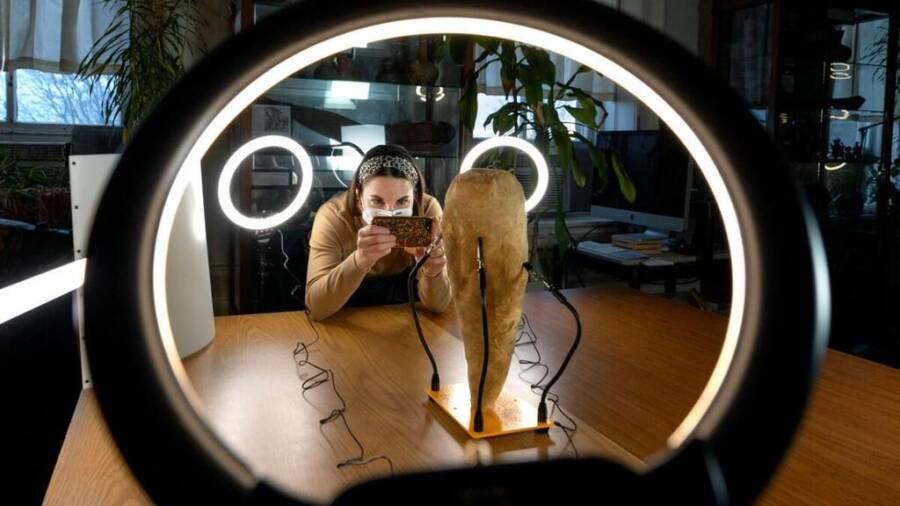
Ryan Young/Cornell UniversityCarol Anne Barsody, a graduate student in archaeology at Cornell University, made the discovery about the ibis.
Barsody first stumble upon the mummy as part of her research . Hoping to study how technology could be integrated into museum showing , she reached out to Frederic Gleach , conservator of Cornell ’s Anthropology Collections . He alerted her to two small mummies which had sat in a closet for nearly one hundred years . One was full of branchlet ; the other contained a bird .
Both Barsody and Gleach were determined not to shake up the mummy . They wanted to use engineering to study it without put down it .
“ Much of archaeology is destructive , ” Gleach told theCornell Chronicle . “ Once you ’ve excavated something , there ’s no unexcavating it . Once you ’ve unwrapped a mummy , there ’s no putting it back together again . ”
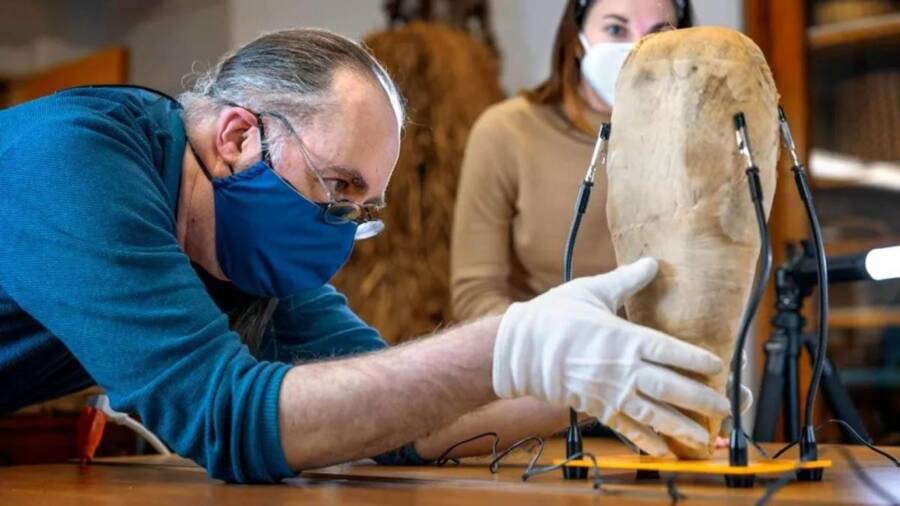
Ryan Young/Cornell UniversityFrederic Gleach, with Barsody in the background, examines the ibis mummy.
As such , they fetch the “ war hawk mummy ” to the College of Veterinary Medicine ( CVM ) . There , according toCNN , CT scans expose that the bird was a male person ibis , not a mortarboard . Not only that , but it was potential between 1,000 and 3,000 years old , and some of its lenient tissue was still entire .
Ancient Egyptians sometimes sacrificed these long - legged birds to the god Thoth . Often depicted with the head of an ibis , Thoth was the god of the moonshine , reckoning , learning , and writing . bouncy Sciencereports that gazillion of these birds have been found in Egyptian necropolises .
But meaning mysteries swirl around the ibis found at Cornell . For starters , researchers found that the doll ’s head had been twisted back and laid against its organic structure — which account for the mummy ’s strange embodiment . The ibis ’ rib cage and sternum had also been removed which , according to theCornell Chronicle , “ was not a common practice . ”
Ryan Young / Cornell UniversityFrederic Gleach , with Barsody in the desktop , try the ibis mummy .
What ’s more , Barsody is n’t precisely sure how the ibis made its way from Egypt to Ithaca , New York , where Cornell is locate . At first , she mean that the ibis mummy may have accompany a human mammy named Penpi , who arrived at the university in 1884 . But Penpi come along to have arrived without other artifacts .
Presently , Barsody suspects that the ibis mummy may have been donate to Cornell in 1930 by an graduate who sent a phone number of artifacts to the school from Saqqara , Egypt . To learn more , she ’s hop to compare its DNA with the deoxyribonucleic acid of other ibis found in Egyptian grave , which might help narrow down when and where it lived .
Barsody also has magnanimous destination for the ibis itself . For her , the next stone’s throw is to create a 3D figure of speech of the ibis , which will be twist into a hologram , as well as a digital file that the great unwashed could download onto their mobile phone phones .
“ I come from a very small Ithiel Town , and we do n’t have any museum near where I grew up or that were easily approachable , ” she told CNN . “ Really the first time that I was able to chatter a museum was when I was in university , which is crazy to conceive about . ”
To theCornell Chronicle , she added : “ The goal is to gauge the world ’s readiness for exhibitions without the artifacts . That gets into bigger doubt about repatriation , institutional collecting practices , admission , and didactics in this post - COVID world , where you might not be able to really get to a museum . I ’m really concerned in the multisensory panorama . Using not just your sight , but also finger , smell , listening . ”
only put , she said , “ I want to contribute the skirt back to life . ”
After reading about the mummified ibis come up at Cornell , discover the report of the2,000 - twelvemonth - older pregnant mom . Or , see how archaeologists find the remains of threecats in an ancient Egyptian mummy .
