When you purchase through links on our site , we may make an affiliate military commission . Here ’s how it works .
The most common and aggressive brain tumour grows by turning normal brain cells into stem cellphone , which can incessantly replicate and regrow a tumor with only a fistful of cells leave behind , Modern inquiry finds .
The findings help explicate whythe tumour , called glioblastoma , are so hard to treat , said study research worker Inder Verma , a molecular biologist at The Salk Institute in California . Even the surgical removal of a tumour may not be able-bodied to extract every individual cancerous electric cell , Verma told LiveScience .

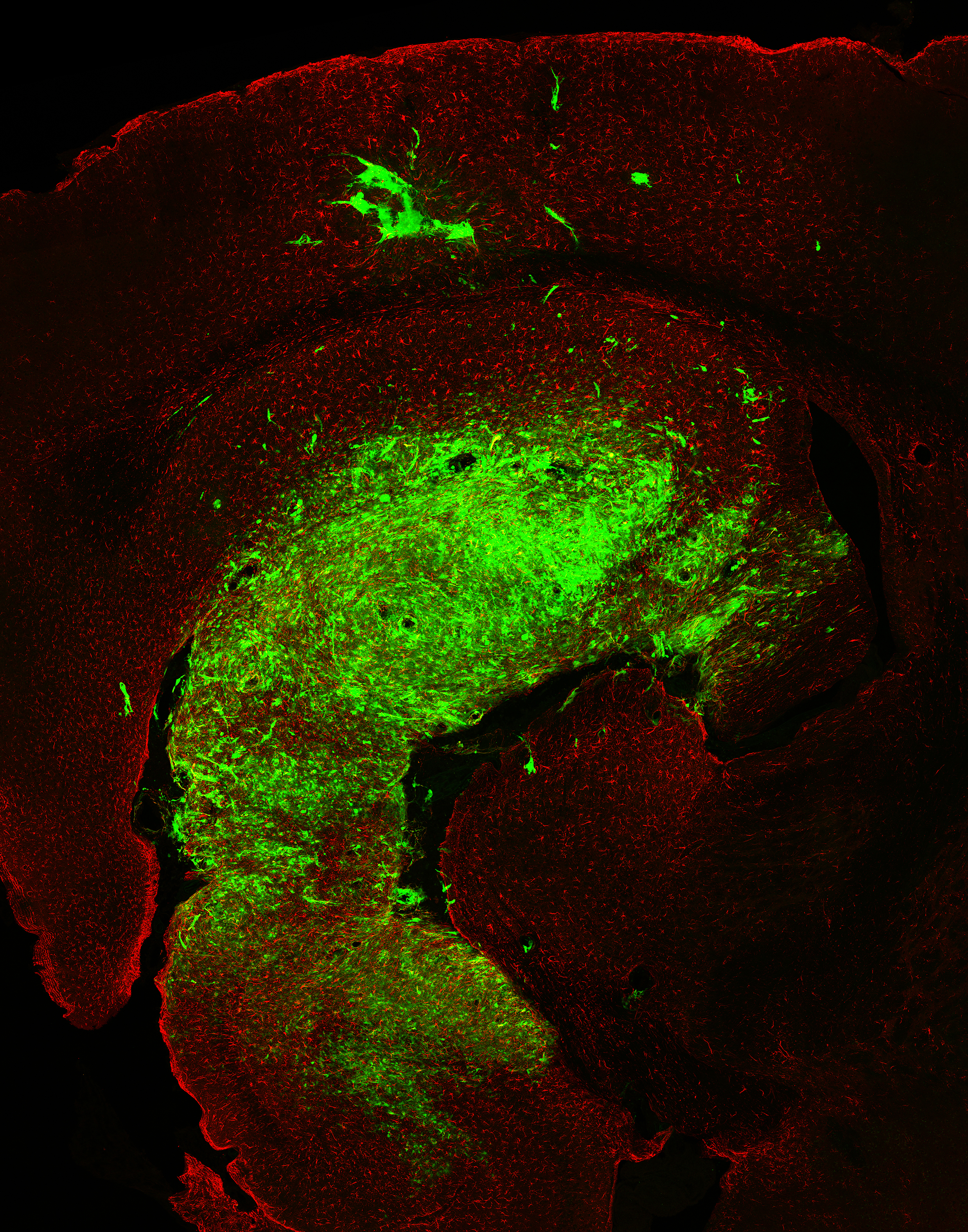
A glioma (green) grows in a mouse brain. The glioma cells express a biological marker (in red) indicating their transformation into stem cells.
Glioblastomas " reoccur because every cellular phone that is leave behind has the ability to start all over again , " Verma said .
Aggressive tumors
spongioblastoma multiforme tumors make up the majority of mental capacity tumour cases and have a verypoor prospect . According to a 2010 study in CA : A Cancer Journal for Clinicians , the fair selection rate after a glioblastoma diagnosis is 14 months ( though better operative techniques had boosted that numeral from 10 month in only five long time prior to the study ) .

Verma and his co-worker were concerned in finding a more accurate direction of studying tumor growth . Most shiner subject field of cancer introduce human tumor cells into computer mouse with no immune systems or genetically engine driver mouse so that every cubicle is cancer - prostrate . But that ’s not how tumors arise in veridical lifespan , Verma said . He and his co - researchers wanted to find a way to mimic cancer ’s growth from a individual cell to out - of - control .
Using viruses , they introduced cancer - causing genes into black eye , develop a proficiency in which as few as 20 cancerous cells can trigger tumour development . They then found that a mere 10 cells from one of these mouse neoplasm , transplanted into a tidy computer mouse , could lead to a whole new neoplasm in that computer mouse . [ Colorful But pernicious : image of Brain Cancer ]
" That suggested that every cell in these tumor or spongioblastoma has the power to make new spongioblastoma , " Verma say .

radical mobile phone trade
Researchers once believed that glioblastomas uprise only from glial cells , the " support " cellphone in the brain that hem in neurons . When it was discovered that the wit containsstem mobile phone , which are capable of transmute into any form of neural tissue , research worker figured cancer could rise from those mobile phone , too , sound out subject researcher Dinorah Friedmann - Morvinski , also a Salk Institute researcher .
But now , Friedmann - Morvinski , Verma and their colleagues have observe they can coax even nerve cell into cancer cells by introduce malignant neoplastic disease - stimulate cistron . The neurons , which should not be able to part and reproduce any longer , turn back into stem cell , which can continuously separate .

research worker have successfully reprogrammed cells into root cells in the lab , a feat that take in scientists John B. Gurdon and Shinya Yamanaka the2012 Nobel Prize in Medicine . It was surprising , still , to see the cancer cell performing this fast one , Friedmann - Morvinski told LiveScience , but there were " some hints it might be happening . "
The next gradation , the researchers state , is to learn more about how the cell revert into stem cells and then find a style to block the out - of - ascendence development of these cancerous cells .
" You have to kill them for kill the tumor in the long run , " Verma say .

The researchers report their results online today ( Oct. 18 ) in the daybook Science .